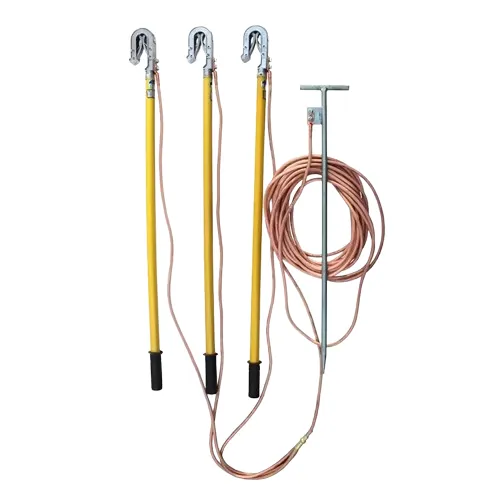
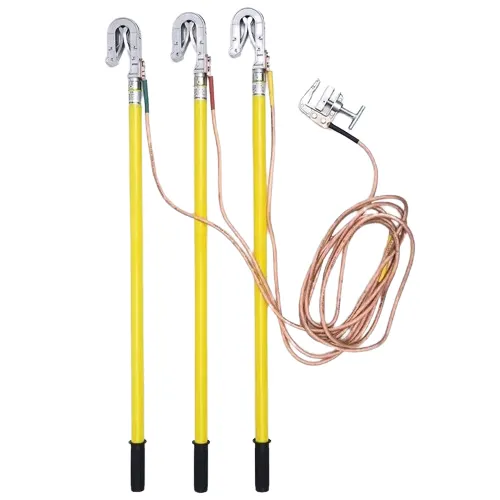
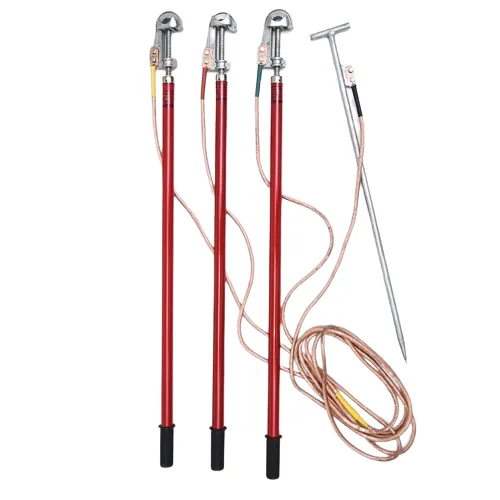
- Kei roto i te nuinga o nga Rakau Whenua, Tauera Whenua, Rawhi Whenua, Pin Whenua ranei.
- I te nuinga o te waa, e toru nga huarahi hei hono me te whakairi i nga taputapu papa whenua.
- Momo huinga, momo tandem me te momo wahanga Kotahi.
Ka taea e taatau te whakarite i tenei hua kia rite ki nga whakaritenga.
|
Tauira |
Ground Cwaea o runga Rahi |
E taunaki ana Te roa o Cwaea o runga |
Te roa o Rakau Papa |
Te maha o Rakau Papa |
|
BLDX-0.4KV |
16mm² |
3x1.5m+8m |
0.5m |
3 rakau / huinga |
|
BLDX-10KV |
25mm² |
3x1.5m+10m |
1.0m |
3 rakau / huinga |
|
BLDX-35KV |
35mm² |
3x1.5m+10m |
1.5m |
3 rakau / huinga |
|
BLDX-110KV |
35mm² |
3x2m+12m |
2.0m |
3 rakau / huinga |
|
BLDX-220KV |
50mm² |
3x2m+15m |
3.0m |
3 rakau / huinga |
|
Tohu: Ka taea te whakarite i te rahi kia rite ki o hiahia. |
||||
Kei te heke mai
- Ka taapirihia e te kakau rapa nga raina kore-paheke me te remu kiriweti kia pai ake te hopu me te whakamahi haumaru.
- Ko te tinana ngongo o te whenua he mea hanga ki te epoxy resin te muka karaihe, he pai te whakamaarama me te haumaru teitei.
- Ko te konumohe kua oti pai te rongoa te rawhi mo te papa whenua, e whakaatu ana i te tino pakeke, te kaha o te whakakoi, me te mauroa, e whakarite ana i te whakamahinga roa mo koe.
- Rawhi turanga arero-rua, he mea hanga ki te konumohe-kounga teitei, he pakari, he roa. Ko te waahi rawhi he nuku-aukati hei whakanui i te waku.
- Waea parahi parakore, he mea hanga mai i te waea parahi ngohengohe maha, he pai te kawe hiko. He mea whakakikoruatia ki te paparanga whakamarumaru whakamarumaru maamaa, teitei-te-te-mahana, hei aukati i te kakahu me te pakaru o te waea papa i te wa e whakamahia ana. Ka tutuki te waea parahi ki nga whakaritenga whakamatautau ngenge, me te whakarite i te haumaru o nga kaiwhakahaere i te wa e mahi ana.
- Ko nga kohao rua-rua, ko te waea o te papa whenua kua kuitihia ki nga lugs parahi, a ka hipokina ano te waea papa ki te ngongo kirihou whakamaarama maramara, ka tino whakanui ake i te haumaru o te waea papa.
Why High Voltage Temporary Short Circuit Earthing Sets Are Essential for Fault Prevention
High Voltage Temporary Short Circuit Earthing Sets are critical safety devices used to protect electrical workers and power systems during maintenance, inspection, and emergency operations. These grounding sets create a controlled short circuit path that safely diverts unexpected electrical energy away from workers, preventing accidental energization, induced voltages, and electrical faults that could result in severe injury or system damage. In high-voltage networks where operational risks are significant, earthing sets form a core component of fault prevention and system stability.
One of the primary reasons these earthing sets are essential is their ability to provide a low-resistance pathway for fault currents. When maintenance is performed on power lines, transformers, or switchgear, the electrical system must be isolated. However, isolation alone cannot guarantee complete safety. Residual charges, back-feed from interconnected circuits, or accidental re-energization can still occur. High Voltage Temporary Short Circuit Earthing Sets eliminate these risks by ensuring any unexpected current flows harmlessly to ground.
Another key factor is worker protection. High-voltage environments expose technicians to induced voltages created by nearby energized conductors. Without grounding, these induced voltages can reach dangerous levels. By applying temporary earthing, induced energy is neutralized, keeping electrical potential at safe levels and providing a secure environment for maintenance teams.
From a system reliability perspective, temporary short circuit earthing sets help prevent equipment damage during faults. If a line is mistakenly energized while workers are present, the grounding set forces the system into a short circuit condition that activates protective relays and circuit breakers. This rapid disconnection minimizes arc flash intensity and prevents catastrophic damage to electrical infrastructure.
These grounding sets also support industry compliance. Electrical safety regulations require proper bonding and grounding procedures before any work is conducted on de-energized lines. Using certified High Voltage Temporary Short Circuit Earthing Sets ensures adherence to safety standards and reduces liability for utility companies.
In summary, these earthing sets are indispensable for fault prevention because they protect workers, stabilize electrical systems, reduce equipment damage, and ensure regulatory compliance. Without them, high-voltage maintenance would be significantly more dangerous and less controlled.
Using High Voltage Temporary Short Circuit Earthing Sets for Overhead Line Earthing Operations
High Voltage Temporary Short Circuit Earthing Sets play a vital role in ensuring worker safety during overhead line earthing operations. When utility crews perform maintenance on transmission or distribution lines, they must create a safe work zone by attaching grounding clamps and conductors that provide a direct path for any unexpected electrical energy to flow to earth. This prevents hazardous voltages from remaining on the line and ensures complete protection against induced currents, lightning surges, and accidental re-energization.
Overhead line operations often involve long conductive spans that are exposed to environmental and electrical influences. Even when lines are disconnected, electromagnetic induction from nearby energized circuits can create dangerous voltages. Temporary earthing sets eliminate this risk by equalizing electrical potential and keeping the line effectively grounded throughout the operation.
The process begins with selecting the appropriate earthing set based on the voltage level, fault current capacity, and conductor size. The earthing set typically consists of insulated sticks, high-strength clamps, flexible copper cables, and an earth-end connector. Workers first attach the earth clamp to a designated grounding point, ensuring a solid connection to the substation grounding grid or an approved earthing rod. This step establishes the earth reference before any connection is made to the overhead line.
Next, workers use an insulated operating stick to install line clamps on each phase conductor. By connecting all phases together and tying them to ground, the High Voltage Temporary Short Circuit Earthing Set ensures the line is at zero potential. This configuration protects maintenance personnel from unexpected electrical surges and ensures that if the line is accidentally energized, the fault current will immediately trip upstream protection devices.
These earthing sets are also essential when performing work such as replacing insulators, installing hardware, inspecting conductors, or addressing storm-related damage. The grounding arrangement stabilizes the system and creates an electrically safe environment for all crew members working at height.
Regular training is necessary to ensure crews understand correct installation techniques. Proper cleaning, inspection, and testing of earthing equipment also guarantee consistently high performance. Damaged or contaminated grounding components can compromise safety, so routine checks are mandatory.
In conclusion, High Voltage Temporary Short Circuit Earthing Sets are indispensable for overhead line earthing operations. They protect workers from induced voltages, create a safe work zone, ensure rapid fault clearance, and enhance the reliability of high-voltage maintenance activities.