







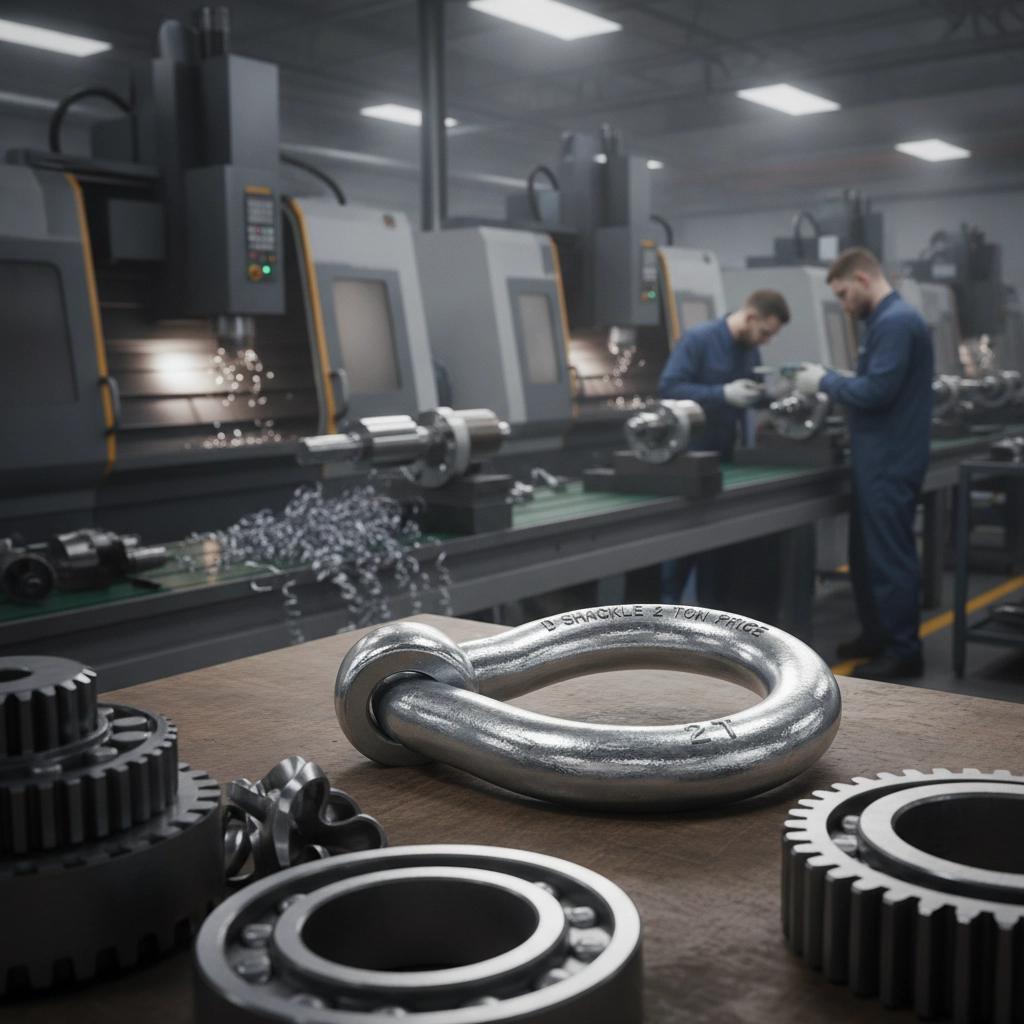
Rigging hardware serves as the critical link in heavy lifting and tensioning operations, where the failure of a single component can lead to catastrophic structural collapse or personnel injury. Among these, the D-shackle—characterized by its bow-shaped body and removable pin—is a staple in construction and power equipment utility. Understanding the technical requirements for a 2-ton capacity shackle is essential for ensuring operational safety and regulatory compliance in industrial environments.
For procurement managers and site engineers, the d shackle 2 ton price is often a secondary consideration compared to the Working Load Limit (WLL) and the material grade. In B2B sourcing, the true value is measured by the total cost of ownership, which includes the lifespan of the hardware under high-stress cycles and its resistance to harsh operational environments, such as high-voltage utility sites or coastal construction zones.
This technical guide explores the engineering principles behind medium-duty shackles, providing a framework for selecting hardware that balances cost with uncompromising safety. Readers will learn how to evaluate material specifications, understand the impact of safety factors, and identify the key markers of professional-grade rigging equipment to avoid common procurement pitfalls.
Understanding Rigging Hardware Fundamentals
A D-shackle, also known as a bow shackle, is designed to connect slings, chains, and cables to a load. Unlike anchor shackles, the bow shape allows it to handle side-loading more effectively, although it is still primarily intended for straight-line tension. The fundamental physics of a 2-ton shackle involve the distribution of stress across the alloy steel body and the shear strength of the pin. In professional power and cable laying applications, these components must maintain their integrity under dynamic loads, where sudden shifts in weight can multiply the effective force applied to the hardware. Quality manufacturing ensures that the pin threads are precisely machined to prevent loosening under vibration, a common issue in heavy machinery environments. By utilizing high-grade carbon steel or alloy steel, manufacturers can ensure that the hardware withstands the rigorous demands of utility construction while maintaining a compact form factor for ease of use.
Critical Evaluation of D Shackle Procurement
Selecting rigging hardware requires a shift from simple price-comparison to a technical audit of the component's capabilities. When evaluating shackles for 2-ton operations, the following dimensions of quality and performance must be analyzed to ensure they meet the specific demands of the industrial application.
Working Load Limit (WLL) Analysis
The Working Load Limit is the maximum mass or force which the product is authorized to support in general service. For a 2-ton shackle, the WLL is not a suggestion but a strict safety boundary. Buyers must distinguish between the WLL and the breaking strength; the former is a safe operational limit, while the latter is the theoretical point of failure. Misunderstanding this distinction often leads to dangerous overloading in the field.
| Evaluation Factor | Requirement | Risk of Failure | Buyer Check |
|---|---|---|---|
| WLL Accuracy | Certified 2 Ton | Structural Deformation | Check embossed marking |
| Load Angle | 0-45 Degrees | Reduced Capacity | Verify load path |
| Dynamic Loading | Low Impact | Sudden Fracture | Assess load stability |
| Pin Fit | Tight Tolerance | Wear and Tear | Test pin rotation |
| Material Grade | Alloy Steel | Metal Fatigue | Request Mill Certificate |
| Surface Finish | Galvanized/Coated | Oxidation | Inspect coating thickness |
Material Grade and Durability
The durability of a shackle depends heavily on the alloy composition. High-carbon steel provides the necessary hardness, while specific alloying elements increase toughness and impact resistance. In B2B contexts, sourcing from a supplier that emphasizes material research—similar to BILO's collaboration with academic institutions for material enhancement—ensures that the hardware does not become brittle in cold climates or lose strength in high-temperature environments.
Pin Security and Locking Mechanisms
The pin is the most vulnerable point of a shackle. Screw-pin shackles allow for quick assembly and disassembly, making them ideal for temporary rigging. However, for long-term installations, bolt-type shackles with castle nuts and cotter pins are required to prevent the pin from backing out due to vibration. Professional procurement focuses on the thread pitch and the precision of the pin-to-body interface to prevent shearing.
Environmental Corrosion Resistance
In power and cable equipment industries, hardware is often exposed to moisture and chemical pollutants. Hot-dip galvanization is the industry standard for protecting against rust. A thin zinc plating may suffice for indoor use, but for utility tools used in field construction, a thick, uniform galvanized layer is necessary to prevent pitting corrosion, which can create stress concentrators and lead to premature failure.
Safety Factor Standards
A safety factor (usually 4:1 or 6:1) represents the ratio between the breaking strength and the WLL. If a 2-ton shackle has a 5:1 safety factor, its theoretical breaking point is 10 tons. Procurement teams must verify these ratios through technical data sheets, as lower-cost, uncertified hardware often omits these margins, posing a significant risk to site safety and insurance compliance.
Dimensional Compatibility
The "bow" of the D-shackle must be wide enough to accommodate the slings or cables without causing "crowding" or pinching. Overcrowding the bow can introduce side-loading forces that the shackle was not designed to handle, effectively reducing its 2-ton capacity. Ensuring the inner diameter matches the cable diameter is a key step in preventing cable wear and premature fraying.
Verification and Certification
Authentic industrial hardware must be traceable. This includes batch numbers and certifications that prove the hardware has undergone proof-loading tests. When auditing a supplier, buyers should look for consistent quality control management and a track record of exporting to regulated markets, ensuring that the products meet international safety standards rather than just minimum specifications.
အမြဲမေးလေ့ရှိသောမေးခွန်းများ
What is the difference between a D-shackle and an Anchor shackle?
A D-shackle (or bow shackle) has a rounded, bow-shaped body that allows it to accept wider slings and handle slight side-loading more effectively. An anchor shackle has a straight, U-shaped body, which is more compact and primarily designed for straight-line pulling. While both can be rated for 2 tons, the D-shackle is generally more versatile for complex rigging scenarios.
How often should a 2-ton shackle be inspected for wear?
Industrial rigging hardware should be inspected before every single lift. For permanent installations, a monthly professional audit is recommended. Inspectors should look for "necking" (elongation of the body), pin deformation, cracks, or excessive corrosion. If the body has stretched by more than 10% of its original dimension, the shackle must be decommissioned immediately.
Can I use a 2-ton shackle for a load that is exactly 2 tons?
While the Working Load Limit (WLL) is 2 tons, it is professional best practice to avoid operating at 100% capacity for extended periods. In dynamic environments where the load may shift or bounce, the effective force can exceed the static weight. Engineers often recommend a buffer, using hardware rated for 25-50% more than the maximum expected static load to account for dynamic variables.
What causes the pin of a shackle to seize or become stuck?
Pin seizure is typically caused by oxidation (rust) or the ingress of abrasive particulates like sand and grit. This is common in coastal or construction environments. Using galvanized hardware and applying a light industrial lubricant to the threads can prevent this. If a pin is seized, never use a torch to heat it, as this can alter the heat treatment of the steel and compromise its structural integrity.
How do I verify if a shackle is truly rated for 2 tons?
Check for three things: first, the WLL must be clearly embossed or stamped on the body of the shackle. Second, verify the manufacturer's mark. Third, request a Mill Test Certificate (MTC) from the supplier. A reputable supplier will provide documentation proving the material grade and the results of the proof-load tests performed during production.
Are all 2-ton shackles compatible with any cable type?
No. Compatibility depends on the diameter of the cable or sling. If the cable is too thick, it will not sit properly in the bow, creating an offset load that can twist the shackle and reduce its capacity. Always match the shackle's interior width to the diameter of your rigging gear to ensure the load is centered and distributed evenly across the pin.
References and further reading
- International Standard for Rigging Hardware - Material and Load Testing Protocols.
- Industrial Lifting Safety Guide: Selection and Maintenance of Alloy Steel Shackles.
- OSHA Guidelines for Slings and Rigging Hardware Inspection.





