



-
 Afrikaans
-
 Albanian
-
 Amharic
-
 Arabic
-
 Armenian
-
 Azerbaijani
-
 Basque
-
 Belarusian
-
 Bengali
-
 Bosnian
-
 Bulgarian
-
 Catalan
-
 Cebuano
-
 Corsican
-
 Croatian
-
 Czech
-
 Danish
-
 Dutch
-
 English
-
 Esperanto
-
 Estonian
-
 Finnish
-
 French
-
 Frisian
-
 Galician
-
 Georgian
-
 German
-
 Greek
-
 Gujarati
-
 Haitian Creole
-
 hausa
-
 hawaiian
-
 Hebrew
-
 Hindi
-
 Miao
-
 Hungarian
-
 Icelandic
-
 igbo
-
 Indonesian
-
 irish
-
 Italian
-
 Japanese
-
 Javanese
-
 Kannada
-
 kazakh
-
 Khmer
-
 Rwandese
-
 Korean
-
 Kurdish
-
 Kyrgyz
-
 Lao
-
 Latin
-
 Latvian
-
 Lithuanian
-
 Luxembourgish
-
 Macedonian
-
 Malgashi
-
 Malay
-
 Malayalam
-
 Maltese
-
 Maori
-
 Marathi
-
 Mongolian
-
 Myanmar
-
 Nepali
-
 Norwegian
-
 Norwegian
-
 Occitan
-
 Pashto
-
 Persian
-
 Polish
-
 Portuguese
-
 Punjabi
-
 Romanian
-
 Russian
-
 Samoan
-
 Scottish Gaelic
-
 Serbian
-
 Sesotho
-
 Shona
-
 Sindhi
-
 Sinhala
-
 Slovak
-
 Slovenian
-
 Somali
-
 Spanish
-
 Sundanese
-
 Swahili
-
 Swedish
-
 Tagalog
-
 Tajik
-
 Tamil
-
 Tatar
-
 Telugu
-
 Thai
-
 Turkish
-
 Turkmen
-
 Ukrainian
-
 Urdu
-
 Uighur
-
 Uzbek
-
 Vietnamese
-
 Welsh
-
 Bantu
-
 Yiddish
-
 Yoruba
-
 Zulu



Nov . 06, 2025 13:50 ត្រឡប់ទៅបញ្ជី
Lever Hoist – Heavy-Duty, Smooth Ratchet Control & Safety
Manual Lever Hoist: field notes, specs, and what buyers actually ask
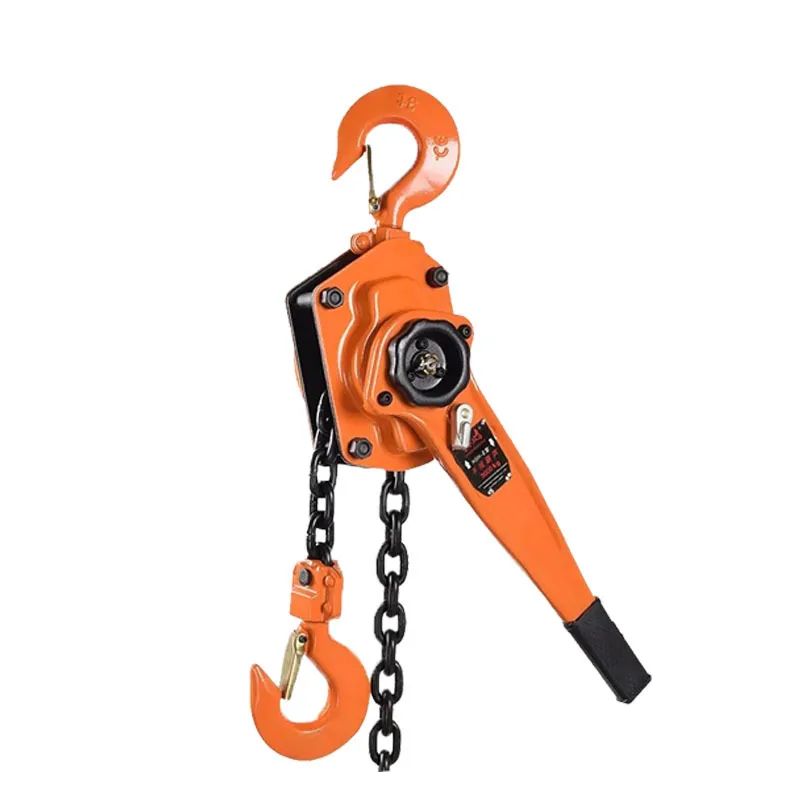
If you work around rigging long enough, you realize one tool gets pulled out more than any other for awkward, off-grid lifts: the humble Lever Hoist. It’s compact, stubbornly reliable, and—when spec’d right—pays for itself the first time you have to drift a load sideways in a tight bay.
What it is (and why crews like it)
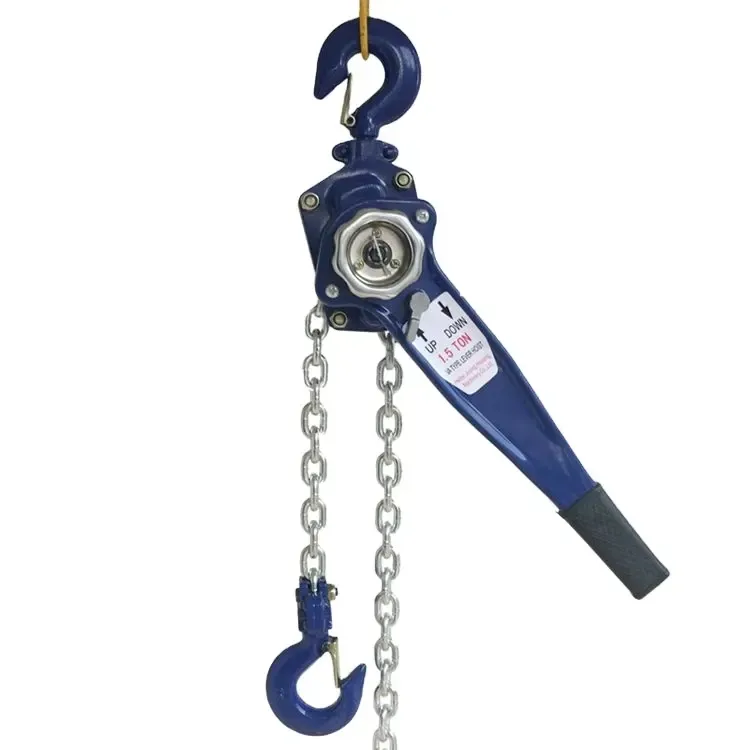
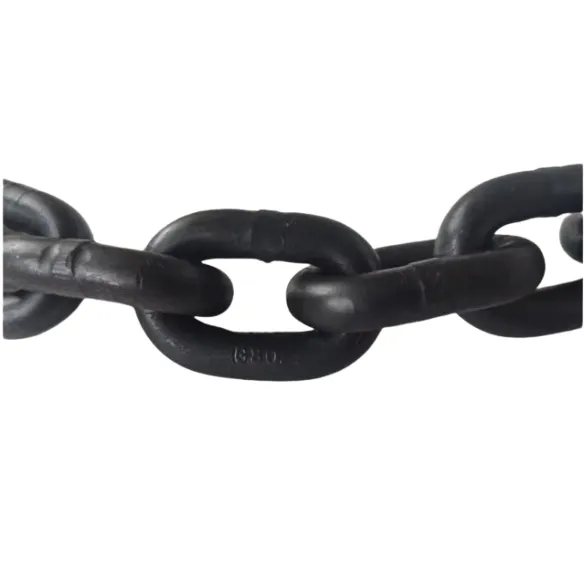
The Manual Lever Hoist—sometimes called a ratchet puller or hand chain block—uses a lever-and-ratchet drive to pull a grade alloy load chain. You get straight-line traction for lifting, lowering, inching, and even side-pulling within limits. Many customers say they prefer it over a hand chain hoist when they need fine control or non-linear traction. Origin: China; the unit here is the Bilopowtel model, which has the usual forged hooks, mechanical brake, and a decent paint job that actually holds up in the yard.
Industry trend check
- More Grade 100 load chain (and even specialty coatings) for better fatigue life.
- Factory overload limiters becoming standard above 1.5 t—good for training-heavy jobsites.
- Smoother pawl/brake geometry reducing handle effort at WLL by ~10–15% in real-world use.
- Documentation drift to EN 13157 and ASME B30.21 alignment, which buyers do read now, surprisingly.
How it’s built (short version)
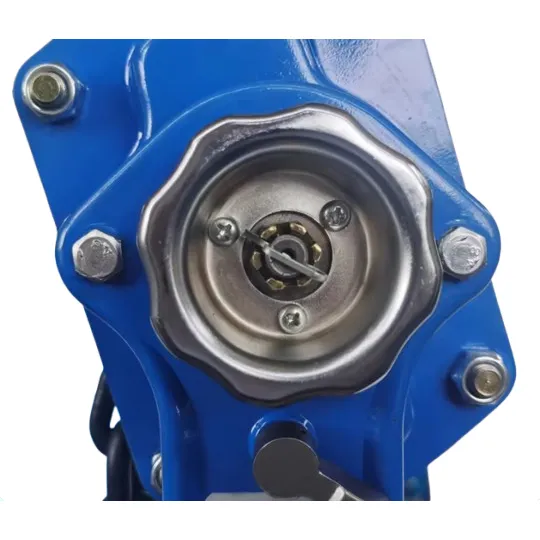
Materials: alloy steel frame and gears; quenched/tempered, shot-peened Grade 80 or 100 load chain; die-forged hooks with safety latches. Methods include precision gear hobbing, induction-hardened pawl/ratchet, zinc-plated or black-oxide chain, powder-coated housings. Testing: proof load ≈ 150% of WLL, brake hold ≥ 125% WLL without slip, fatigue cycling to 1500–2500 cycles by model, and salt-spray (ASTM B117) 48–72 h on exposed parts. Service life? Around 5–10 years with proper inspection and moderate duty.
Typical applications
- Construction: setting embeds, steel fit-up, and panel alignment.
- Utilities: pole work, transformer positioning, and tensioning.
- Marine/shipyards: confined-space lifts, chain stops, and drivetrain alignment.
- Mining and rail: track alignment, conveyor maintenance, pull-tests.
Product specs (popular capacities)
| គំរូ | WLL | Std. Lift | Load Chain | Effort at WLL ≈ | Net Weight ≈ |
|---|---|---|---|---|---|
| 0.75 t | 750 kg | 1.5 m | Ø6 mm, G80/100 | 230–260 N | 6.5 kg |
| 1.5 t | 1500 kg | 1.5 m | Ø8 mm, G80/100 | 280–320 N | 10.5 kg |
| 3 t | 3000 kg | 1.5 m | Ø10 mm, G80/100 | 340–390 N | 21 kg |
| 6 t | 6000 kg | 1.5 m | Ø10×2 fall | 380–420 N | 34 kg |
Note: proof load 1.5× WLL; dimensions/effort vary by configuration; real-world use may vary.
Compliance, tests, and paperwork
Conforms to EN 13157 for hand-powered lifting devices and ASME B30.21 in scope. Load chain is built to EN 818-7 (short-link hoist chain). Factory options include CE declarations per 2006/42/EC and RoHS for surface finishes. Each Lever Hoist ships with a test certificate showing proof-load, brake hold, and serial traceability. To be honest, I skim them—until the day I need them.
Vendor snapshot (what buyers compare)
| Vendor | Origin | Chain Grade | Overload Limiter | Lead Time ≈ | Certs |
|---|---|---|---|---|---|
| Bilopowtel Manual Lever Hoist | China | G80 / G100 | Optional ≥1.5 t | 2–4 weeks | EN 13157, CE |
| Brand H (JP) | Japan | G100 | Standard | Stock–2 weeks | ASME, CE |
| Brand E (EU) | EU | G80 | Optional | 3–6 weeks | EN 13157 |
Customization and add-ons
- Lift height from 1.5 m to 12 m; shipyard or swivel hooks; ship-ready paint.
- Overload limiter, stainless or spark-reduced kits (consult for hazardous zones).
- Chain grade, finish, and low-temp grease for −20 °C work.
Real-world snapshots
Wind farm service crew: two 1.5 t units used for yaw-drive swap. Proof load certs cleared site QA; average handle effort at WLL measured ~300 N, slightly below spec—operators noticed.
Shipyard alignment: a 3 t Lever Hoist plus a snatch block achieved a multi-angle pull to drift a gear casing 12 mm—no slip on the brake during micro-lowering, which is what the supervisor cared about.
Safety quick notes
- Never exceed WLL; observe derating for angles and side loading.
- Inspect chain for elongation/corrosion; retire if wear > 10% or per standard limits.
- Keep the latch functional; it’s not cosmetic—seen too many removed “for convenience.”
References (authoritative):
- ASME B30.21 – Safety Standard for Lever Hoists, The American Society of Mechanical Engineers.
- ASME HST-3 – Performance Standard for Chain Hoists, ASME.
- EN 13157:2004+A1:2009 – Hand-powered lifting equipment, CEN.
- EN 818-7 – Short link chain for chain hoists, CEN.
- Directive 2006/42/EC – Machinery Directive, European Commission.
ព័ត៌មានចុងក្រោយ
Professional Guide to Cable Installation with Ethernet Fish Tape
ព័ត៌មានJul.01,2026
Professional Cable Installation Guide Using a Fish Tape
ព័ត៌មានJun.29,2026
Professional Cable Installation Guide with 30m fish tape
ព័ត៌មានJun.27,2026
Mastering Cable Installation with the 1 2 fish tape Guide
ព័ត៌មានJun.26,2026
Ultimate Guide to Using 3 8 Fish Tape for Electrical Wiring
ព័ត៌មានJun.25,2026
Best Electric Hoists for Sale A Complete Industrial Buyers Guide
ព័ត៌មានJun.23,2026
- ទំនាក់ទំនង
- ADDRESS: 188, Fengshou Road, Shijiazhuang. China
- អ៊ីមែល៖ info@bilopowtel.com
- ទូរសព្ទ៖ 0086-311-88862036
- WhatsApp៖ 0086-152-26563165





