



-
 Afrikaans
-
 Albanian
-
 Amharic
-
 Arabic
-
 Armenian
-
 Azerbaijani
-
 Basque
-
 Belarusian
-
 Bengali
-
 Bosnian
-
 Bulgarian
-
 Catalan
-
 Cebuano
-
 Corsican
-
 Croatian
-
 Czech
-
 Danish
-
 Dutch
-
 English
-
 Esperanto
-
 Estonian
-
 Finnish
-
 French
-
 Frisian
-
 Galician
-
 Georgian
-
 German
-
 Greek
-
 Gujarati
-
 Haitian Creole
-
 hausa
-
 hawaiian
-
 Hebrew
-
 Hindi
-
 Miao
-
 Hungarian
-
 Icelandic
-
 igbo
-
 Indonesian
-
 irish
-
 Italian
-
 Japanese
-
 Javanese
-
 Kannada
-
 kazakh
-
 Khmer
-
 Rwandese
-
 Korean
-
 Kurdish
-
 Kyrgyz
-
 Lao
-
 Latin
-
 Latvian
-
 Lithuanian
-
 Luxembourgish
-
 Macedonian
-
 Malgashi
-
 Malay
-
 Malayalam
-
 Maltese
-
 Maori
-
 Marathi
-
 Mongolian
-
 Myanmar
-
 Nepali
-
 Norwegian
-
 Norwegian
-
 Occitan
-
 Pashto
-
 Persian
-
 Polish
-
 Portuguese
-
 Punjabi
-
 Romanian
-
 Russian
-
 Samoan
-
 Scottish Gaelic
-
 Serbian
-
 Sesotho
-
 Shona
-
 Sindhi
-
 Sinhala
-
 Slovak
-
 Slovenian
-
 Somali
-
 Spanish
-
 Sundanese
-
 Swahili
-
 Swedish
-
 Tagalog
-
 Tajik
-
 Tamil
-
 Tatar
-
 Telugu
-
 Thai
-
 Turkish
-
 Turkmen
-
 Ukrainian
-
 Urdu
-
 Uighur
-
 Uzbek
-
 Vietnamese
-
 Welsh
-
 Bantu
-
 Yiddish
-
 Yoruba
-
 Zulu



Apr . 17, 2026 16:16 Ar ais chuig an liosta
High Efficiency Cobra Duct Rod for Underground Cable Installation
In the demanding world of underground utility installation, the efficiency of cable pulling often hinges on the quality of the tools used to navigate complex conduits. The cobra duct rod has emerged as a critical solution for technicians facing the challenge of routing fiber optics and power cables through obstructed or winding paths. By combining flexibility with high tensile strength, these rods reduce the risk of cable damage and significantly decrease the time required for deployment.
Globally, the push toward digitalization and 5G expansion has led to a surge in demand for sophisticated cable laying tools. Industry standards, often aligned with ISO quality benchmarks, emphasize the need for equipment that can withstand harsh subterranean environments without failing. The slat ducht cobra addresses these needs by providing a reliable mechanism to bridge the gap between manholes, ensuring that infrastructure projects stay on schedule and within budget.
Understanding the technical nuances of duct rods—from material composition to guidance head design—is essential for any construction or utility firm. Whether dealing with municipal sewage systems or dedicated telecommunications ducts, the right choice of rod can mean the difference between a seamless installation and a costly project delay. This guide explores the engineering, application, and future of the slat ducht cobra in modern infrastructure.
The Engineering Fundamentals of Cobra Duct Rods
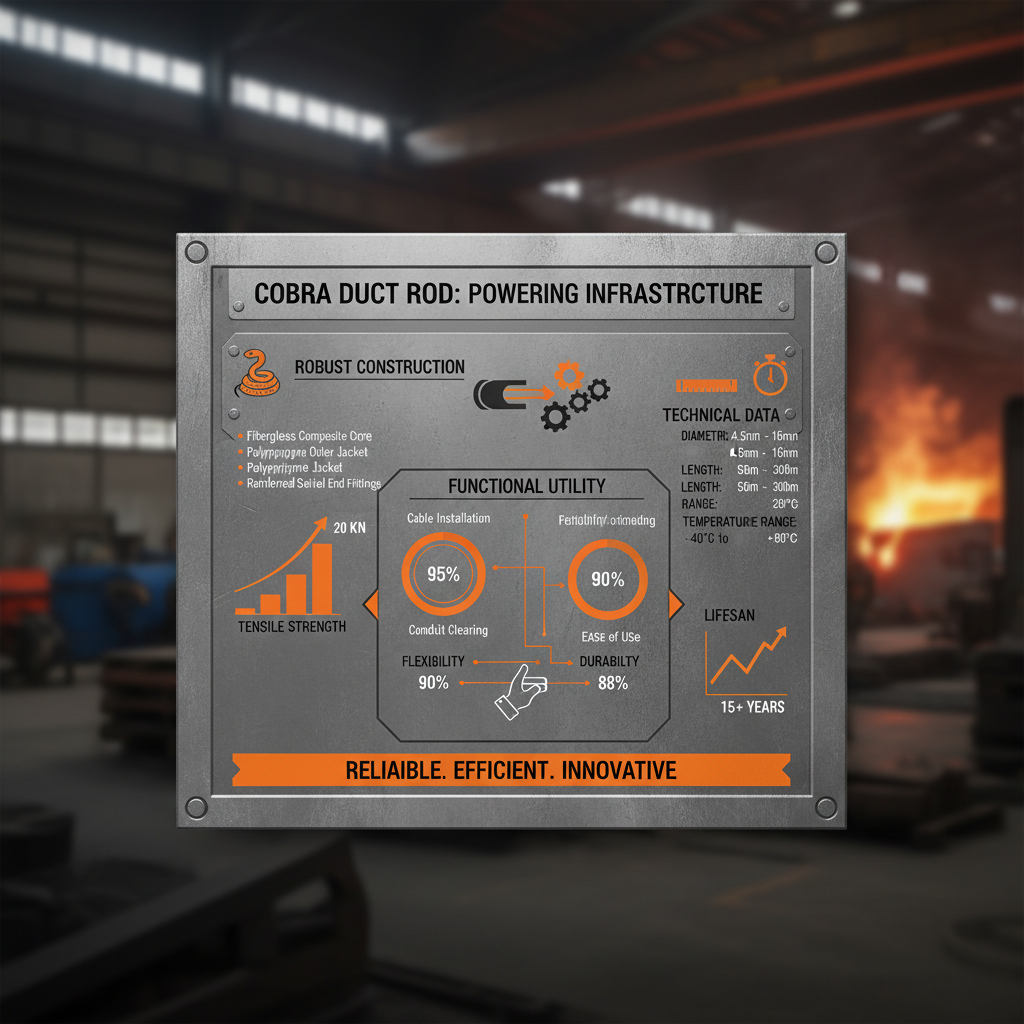
An cobra duct rod is engineered to solve the "blind push" problem inherent in underground pipework. Unlike traditional steel fish tapes, which can kink or buckle under pressure, the cobra variant utilizes advanced polymers and reinforced fiberglass. This allows the rod to maintain a linear trajectory while possessing enough elasticity to glide through bends and offsets without sacrificing the structural integrity of the conduit.
From a mechanical perspective, the rod is designed to transfer pushing force efficiently from the operator to the lead head. The surface friction is minimized through specialized coatings, which prevent the rod from "binding" against the interior walls of HDPE or PVC pipes. This synergy of rigidity and smoothness makes the slat ducht cobra an indispensable asset for modern utility crews.
CCanna
Unlike steel fish tapes, which are prone to kinking and can be conductive (posing a safety risk), the cobra duct rod is typically made from non-conductive fiberglass or polymer composites. This provides a superior balance of rigidity for pushing and flexibility for navigating bends, while ensuring the safety of the operator in electrical environments.
To prevent kinking, ensure you are using a rod with the appropriate stiffness for your duct diameter. Always push the rod steadily and avoid sudden, jerky movements. Using a properly tensioned reel and ensuring the lead head is correctly seated will also help the rod maintain a linear path through the conduit.
Yes, they are specifically designed for this. The flexible nature of the cobra duct rod allows it to navigate the unpredictable offsets and slight collapses often found in older municipal piping. However, it is recommended to use a high-flexibility polymer variant for legacy systems to maximize the chance of success.
Most cobra duct rods feature a lead head with a pre-drilled hole or a threaded attachment point. Once the rod emerges from the target manhole, you can tie a high-strength jet-line or pull-string securely to this head using a knot or a specialized connector, then pull the rod back out to leave the string in place.
With proper care—including cleaning the rod after use and storing it on a quality reel—a professional cobra duct rod can last for several years. The main wear points are the lead head and the outer coating; replacing the lead head periodically can significantly extend the overall life of the tool.
For distances over 100 meters, we recommend reinforced hybrid or carbon-fiber variants. These materials reduce "bowing" and ensure that the pushing force is transmitted effectively over long spans. For extremely long distances, ensure that there are intermediate access points to assist the push.
Conclusion
An slat ducht cobra represents the intersection of material science and practical utility, transforming a traditionally frustrating task into a streamlined process. By prioritizing non-conductive materials, ergonomic design, and high-tensile strength, these tools not only accelerate the deployment of global communication networks but also enhance the safety and efficiency of the technicians on the front lines of infrastructure.
As we move toward a more connected future, the demand for reliable cable laying tools will only grow. Investing in high-quality conduit solutions is no longer optional but a strategic necessity for any firm aiming for operational excellence. To ensure your projects are equipped with the best technology available, we invite you to explore our full range of professional tools. Visit our website: www.bilopowtel.com
An nuacht is déanaí
Professional Guide to Cable Installation with Ethernet Fish Tape
NuachtJul.01,2026
Professional Cable Installation Guide Using a Fish Tape
NuachtJun.29,2026
Professional Cable Installation Guide with 30m fish tape
NuachtJun.27,2026
Mastering Cable Installation with the 1 2 fish tape Guide
NuachtJun.26,2026
Ultimate Guide to Using 3 8 Fish Tape for Electrical Wiring
NuachtJun.25,2026
Best Electric Hoists for Sale A Complete Industrial Buyers Guide
NuachtJun.23,2026
- TEAGMHÁIL
- SEOLADH: 188, Bóthar Fengshou, Shijiazhuang. tSín
- RÍOMHPHOST: info@bilopowtel.com
- FÓN: 0086-311-88862036
- WHATSAPP: 0086-152-26563165





